Game Thinking Resources
Game Thinking is a proven, step-by-step system for innovating smarter & finding product/market fit.
If you’re familiar with Design Thinking, Lean/Agile, or Gamification – you’re in the right place. Game Thinking embraces these frameworks, & adds proven, cutting- edge techniques from game design & systems thinking to take things further.This system will empower your team to:
- Save time by targeting a high-need, underserved niche
- Drive retention with a sticky Habit Loop & engaging Journey
- Test your end-to-end experience with no-code Storyboards
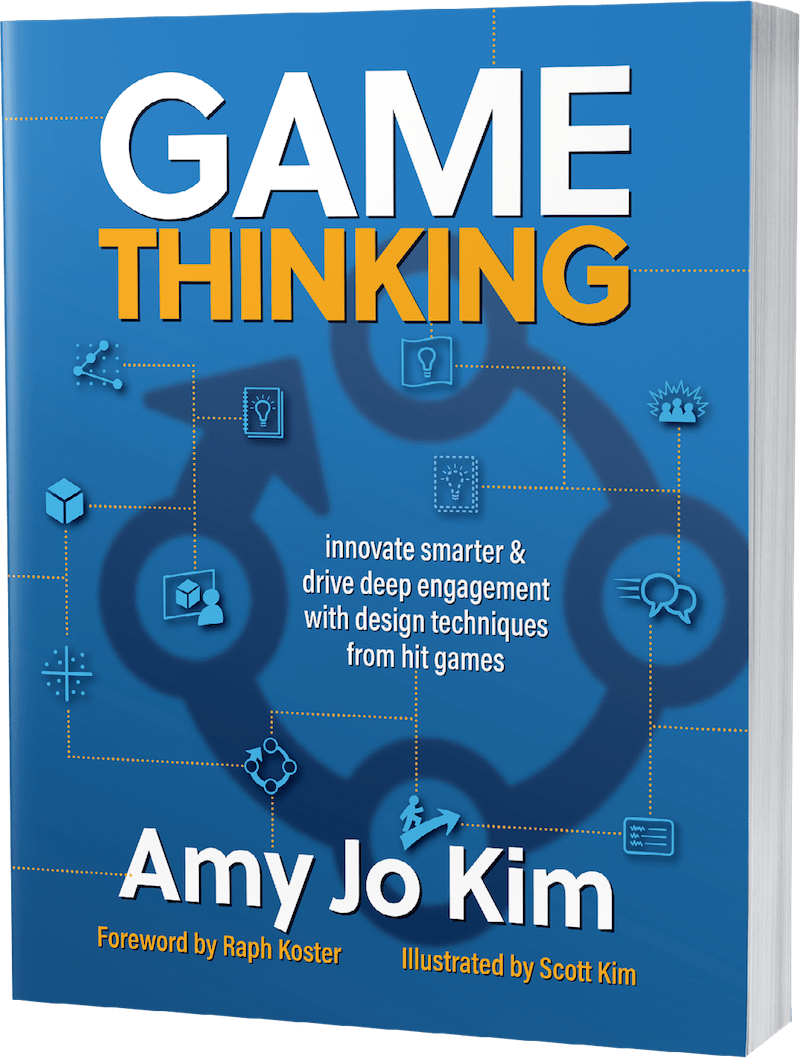
To learn more, read our Game Thinking book – available in paperback, ebook or audiobook.
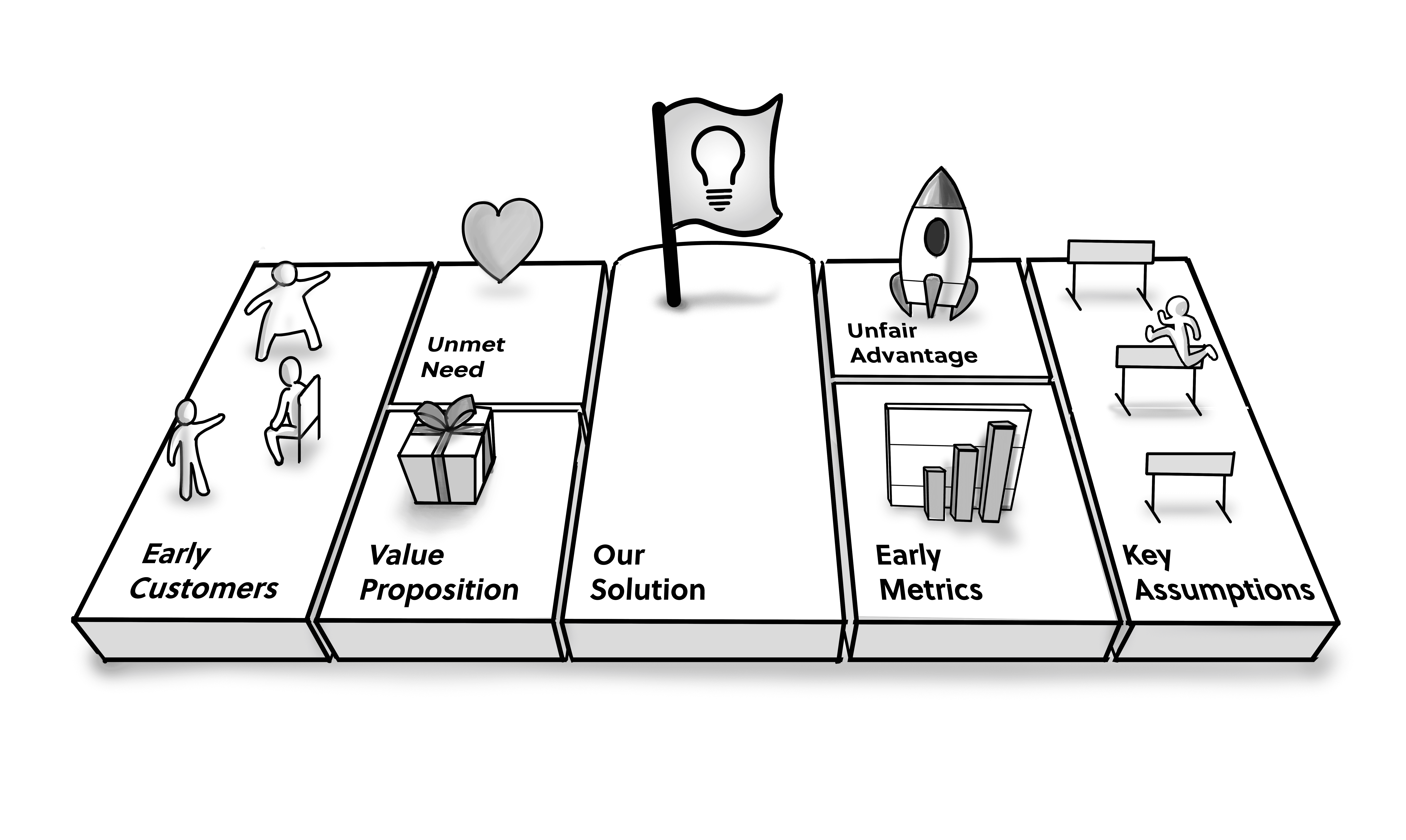
Download your free MVP canvas
To accelerate your learning, here’s a free copy of the MVP canvas — a one-page snapshot of your product concept.
Filling out the MVP canvas is the first step in applying game thinking to your project.
Use the MVP Canvas to prioritize your high-risk assumptions & run the product experiments that matter most.
Online Minicourses
Go deeper into advanced topics
Intro to Cooperative Design. This course introduces you to the principles behind cooperative games — games in which players work together toward a common goal, rather than fighting against each other. Many business success stories, like crowdfunding on Kickstarter crowdfunding and reviews on Amazon, tap into people’s desire to help each other for mutual benefit. Learn the five principles of coop design, and how you can apply it to your product design.
References (with links to buy book)
Alvarez, Cindy. Lean Customer Development: Building Products Your Customers Will Buy. “The term ‘lean’ originally comes from manufacturing. It stresses eliminating waste from processes and making sure the end product is something that the customer wants.”
Buchheit, Paul. Blog Post from July 30, 2014. “Build something a few people love, even if most people don’t get it right away.”
Bartle, Richard. Hearts, Clubs, Diamonds, Spades: Players Who Suit MUDs. “An easy way to remember these is to consider suits in a conventional pack of cards: achievers are Diamonds (they’re always seeking treasure); explorers are Spades (they dig around for information); socialisers are Hearts (they empathise with other players); killers are Clubs (they hit people with them).”
Christensen, Clayton. The Innovator’s Dilemma: When New Technologies Cause Great Firms to Fail. Harvard Business Review Press, 2015. “Many of what are now widely accepted principles of good management are, in fact, only situationally appropriate. There are times at which it is right not to listen to customers, right to invest in developing lower-performance products that promise lower margins, and right to aggressively pursue small, rather than substantial, markets.”
Collins, Jim. Good to Great: Why Some Companies Make the Leap…and Others Don’t. Harper Business, 2001. “All good to great companies have leaders with ferocious resolve, and almost stoic determination to do whatever needs to be done to make the company great. They will sell the mill or fire their brother if that’s what it takes to make the company great.”
Cook, Dan. Loops and Arcs. Lost Garden blog post, 2012. “Since both loops and arcs can be easily nested and connected to one another, in practice you end up with chemistry-like mixtures of the two that can get a bit messy to tease apart. The simplest method of analysis is to ask What repeats and what does not?”
Cook, Dan. Rockets, Cars and Gardens: Visualizing Waterfall, Agile and Stage Gate. Lost Garden blog post, 2006. “A team that learns the quirks of its customers, code, and business rapidly will often out perform teams operating without this knowledge.”
Cooper, Robert. Winning at New Products: Creating Value Through Innovation. “Stage-Gate® has become the most widely used method for conceiving, developing, and launching new products in industry today… I hope this 5th edition sounds a wake-up call that true innovation and bold product development are with your grasp.”
Csikszentmihalyi, Mihaly. Flow: The Psychology of Optimal Experience. Harper Perennial Modern Classics, 2008. “Most enjoyable activities are not natural; they demand an effort that initially one is reluctant to make. But once the interaction starts to provide feedback to the person’s skills, it usually begins to be intrinsically rewarding.”
Drucker, Peter. The Effective Executive: The Definitive Guide to Getting the Right Things Done. Harper Business Essentials, 2006. “Management is largely by example. Managers who can’t manage themselves set the wrong example.”
Fullerton, Tracy. Game Design Workshop. A K Peters, 2014. “The exercises contained in this book require no programming expertise or visual art skills and so release you from the intricacies of digital game production while allowing to you to learn what works and what does not work in your game system. Additionally, these exercises will teach you the most important skill in the game design: the process of prototyping, playtesting, and revising your system based on player feedback.”
Hall, Erika. Just Enough Research. A Book Apart, 2013. “‘Early adopters will put up with cost, ridicule, and friction to get their needs met.”
Hall, Erika. Conversational Design. A Book Apart, 2018. “How do we make digital systems feel less robotic and more real? Whether you work with interface of visual design, front-end technology, or content design, learn why conversation is the best model for creating device-independent, human-centered systems.”
Hoffman, Reid. mastersofscale.com. Podcast and web site. “It’s more important to have 100 people who LOVE your product than one million who just sort of like it.”
Hoffman-John, Erin (Contributor) and Robert J. Mislevy (Author), and contributors Andreas Oranje, Malcolm I. Bauer, Alina von Davier, Jiangang Hao, Seth Corrigan, Kristen DiCerbo, Michael John. Psychometric Considerations in Game-Based Assessment. CreateSpace, 2014. “Applying psychometric concepts to game-based assessment is not simply a matter of applying psychometric methods after-the-fact to games that have been optimized for learning and engagement, then ‘figuring out how to score them.’ A better design process jointly addresses the concerns of game design, instructional design, and assessment as required, so that key considerations of each perspective are taken into account from the beginning. This integrated approach encourages designers to recognized trade-offs that cut across design domains and devise solutions that balance concerns across them.”
Hulick, Sam. UserOnboard.com. “I’m usually highly reluctant to give out my email address, but in this case it’s so refreshing to not have to enter a credit card that it’s actually a relief to ‘only’ have to enter my email address.”
Isbister, Katherine. How Games Move Us: Emotion by Design (Playful Thinking). The MIT Press, 2016. “People who aren’t on the inside of the game world often tell me they fear that games numb players to other people, stifling empathy and creating a generation of isolated, antisocial loners. In these pages, I argue that the reverse is true.”
Klein, Laura. Build Better Products: A Modern Approach to Building Successful User-Centered Products. Rosenfeld Media, 2016. “Better products improve the lives of the people who use them in a way that also improves the company that produces them. In other words, better products make companies more money by making their customers more satisfied.”
Kelley, Tom. The Art of Innovation: Lessons in Creativity from IDEO, America’s Leading Design Firm. Crown Business, 2001. “Fail often to succeed sooner.”
Kim, Amy Jo. Community Building on the Web: Secret Strategies for Successful Online Communities. Peachpit Press, 2006. “Initially, it’s up to you to define your purpose, choose your feature set, and set a particular tone, but as your community grows and matures, your members can and should play a progressively larger role in building and maintaining the community culture.”
Kohn, Alfie. Punished by Rewards: The Trouble with Gold Stars, Incentive Plans, A’s, Praise, and Other Bribes. Houghton Mifflin, 1999. “In fact, the more we use artificial inducements to motivate people, the more they lose interest in what we’re bribing them to do. Rewards turn play into work, and work into drudgery.”
Koster, Raph. A Theory of Fun. O’Reilly Media, 2013. “Fun is just another word for learning.”
McCloud, Scott. Understanding Comics: The Invisible Art. William Morrow, 1994. “When we abstract an image through cartooning, we’re not so much eliminating details as we are focusing on specific details. By stripping down an image to its essential ‘meaning,’ an artist can amplify that meaning in a way that realistic art can’t.”
Moore, Geoffrey. Crossing the Chasm. Harper Business, 2014. “Entering the mainstream market is an act of burglary, of breaking and entering, of deception, often even of stealth.”
Nielsen, Jakob. Paper Prototyping Training Video. Nielsen Norman Group. “Convince skeptical members of your team who do not believe that it is possible to test unpolished designs; showing beats telling.”
Olsen, Dan. The Lean Product Playbook: How to Innovate with Minimum Viable Products and Rapid Customer Feedback. Wiley, 2015. “While the first ‘prototype’ you test could be your live product, you can gain faster learning with fewer resources by testing your hypotheses before you build your product.”
Osterwalder, Alexander and Yves Pigneur. Business Model Generation: A Handbook for Visionaries, Game Changers, and Challengers. Wiley, 2010. “Business Model Generation is a practical, inspiring handbook for anyone striving to improve a business model—or craft a new one.”
Pink, Daniel. Drive: The Surprising Truth About What Motivates Us. Riverhead Books, 2011. “Control leads to compliance; autonomy leads to engagement.”
Portigal, Steve. Interviewing Users: How to Uncover Compelling Insights. Rosenfeld Media, 2013. “Great interviewers make deliberate, specific choices about what to say, when to say it, how to say it, and when to say nothing.”
Ries, Eric. The Lean Startup: How Today’s Entrepreneurs Use Continuous Innovation to Create Radically Successful Businesses. Random House, 2011. “To increase your chances of success, minimize your time through the build-measure-learn cycle.”
Rogers, Everett. Diffusion of Innovations. Free Press, 2003. “Diffusion is essentially a social process through which people talking to people spread an innovation.”
Ryan, Richard M. and Edward L. Deci. Self-Determination Theory: Basic Psychological Needs in Motivation, Development, and Wellness. The Guilford Press, 2017. “That most people show considerable effort, agency, and commitment in their lives appears, in fact, to be more normative than exceptional, suggesting some very positive and persistent features of human nature.”
Schell, Jesse. Art of Game Design: A Book of Lenses. CRC Press, 2008. “Good game design happens when you view your game from as many perspectives as possible.”
Sellers, Mike. Advanced Game Design: A Systems Approach. Addison-Wesley Professional, 2017. “Games seem to me to be unique in their ability to allow us to create and interact with systems, to really get to know what systems are and how they operate.”
Sierra, Kathy. Upgrade your users, not just your product. Blog Post, 2005. “To the brain, learning new things is inherently pleasurable. So if markets are conversations, why not use the conversation to help someone learn?”
Traynor, Des, Paul Adams, Geoffrey Keating. Intercom on Jobs-to-be-Done. Intercom, 2016. “When you’re solving needs that already exist, you don’t need to convince people they need your product.”
Vassallo, Steve. The Way to Design. Foundation Capital, 2017. “Systems thinking is a mindset—a way of seeing and talking about reality that recognizes the interrelatedness of things. Systems thinking sees collections of interdependent components as a set of relationships and consequences that are at least as important as the individual components themselves. It emphasizes the emergent properties of the whole that neither arise directly, nor are predictable, from the properties of the parts.”
Wodtke, Christina. Pencil Me In: The Business Drawing Book for People Who Can’t Draw. Boxes & Arrows, 2017. “Where are the simple books on how to draw for grown-ups? Most books that teach drawing are intimidating. They teach you how to draw buildings or race cars or realistic people, but that’s not what non-designers need to draw every day. I decided to make a book for working professionals that wouldn’t scare anyone away and would teach you how to draw the kinds of things you need to think through product and business decisions.”
Wodtke, Christina. Radical Focus: Achieving Your Most Important Goals with Objectives and Key Results. Cucina Media, 2016. “One: set inspiring and measurable goals. Two: make sure you and your team are always making progress toward that desired end state. No matter how many other things are on your plate. And three: set a cadence that makes sure the group both remembers what they are trying to accomplish and holds each other accountable.”
Zimmerman, Eric and Katie Salen Tekinbas. Rules of Play: Game Design Fundamentals. MIT Press, 2003. “We look closely at games as designed systems, discovering patterns within their complexity that bring the challenges of games design into full view.”